
More than ever, finding ways to save on your electricity bill is vital! So what can you do?
Like you, we’re also doing our best to reduce the cost of running a household. Here are some energy-saving tips to reduce your electricity bill.
We get it!
The cost of running a home in Alberta continues to increase, and there’s no sign of that slowing!
[*UPDATE: umm, what the heck is going on in 2022…?]
Tech uses energy, and there is more and more tech in our lives.
So in this blog, we will turn our electrician expertise to energy-saving…and see if we can’t save ya a few bucks.
“When trying to find ways to save on your electricity bill, start by understanding which part of the bill you can actually affect. Then we can look at how to reduce the amount of electricity you are being charged for. You can do this either through replacing/upgrading items in your home or learning how to use electricity more wisely.”
– Dustin “Wise As A Jedi” Prete, Master Electrician
PRO TIP: consider home automation as a part of your energy and cost savings strategy.
How to Read your Electricity Bill To Understand Where You Can Save Money
To find out how much you can save on your electricity bill, we will look at the most recent bill from a southern Alberta family of 4. They live in a 1200 square foot detached home.

Image: An electricity bill from an Alberta family on a variable rate plan in January-February 2020
Yikes, January and February 2020 were rough months for Alberta’s energy consumers! Not really a surprise as they are high consuming months due to cold temperatures and reduced daylight hours. However, this year, Southern Alberta saw record low temperatures (it was freezing, eh?!) to start the billing period.
On top of that, the Alberta Provincial Government ended the cap on electricity rates as part of its October 2019 budget cuts (outlined on page 138 of their 2020 Fiscal Plan). This rate cap previously prevented Alberta’s residential and small business consumers from paying more than 6.8 cents per kilowatt-hour (kWh). Without the rate cap, you would have noticed a significant hike in the bill you received in February unless you had locked in your rates with your provider.
Now let’s take a look at your bill. We will start where the electricity is generated and work through where the electricity is used by your household.
Transmission Charges
Transmission charges cover the cost of installing, maintaining, and operating the high voltage infrastructure.
This infrastructure is used to move electricity from where it is produced to the distribution system’s substation. Then, it is converted to a lower voltage for consumers. The transmission charge is calculated based on how much electricity is used during the billing period.
Delivery charges
Delivery charges cover the cost of getting the electricity to your home from the distribution system. They go to the distribution company to cover what they spend on installing, maintaining, and operating the infrastructure (wires, poles, transformers, etc.) to convert and transport the electricity from the transmission system to your home.
The delivery charge is calculated by combining a fixed fee. Regardless of your use, and a variable fee, depending on how much electricity you used during the billing period.
Franchise Fee
The franchise fee is charged by your municipal government to the utility company for exclusive rights to distribute to the area and compensation for the public property used for distribution (poles, etc.). It is then passed on to you on each bill.
Administration Charge
This covers the administration costs of billing and customer service.
Energy Charges and Transaction Fees
These are the only charges you can really control, and we have highlighted them on our example bill.
They are calculated by multiplying the meter reading in kWh (your actual energy usage in kilowatt-hours for the billing period) by the current electricity rates or transaction fees per kWh. Now, let’s look at ways to reduce this amount on your next bill.
For more information on energy charges, please visit the Alberta Utilities Commission.
How To Save On Your Electricity Bill
Lighting
If you haven’t already, make the switch to LED lighting!
The average LED light uses 70% less energy than an incandescent bulb. To compare, a 60W incandescent bulb (a bulb that uses 60 watts per hour) puts out 800 lumens of light. The same lumen (light) output in an average LED bulb only uses 12 watts! Some LEDs are even more efficient and can exceed this lumen/W output.
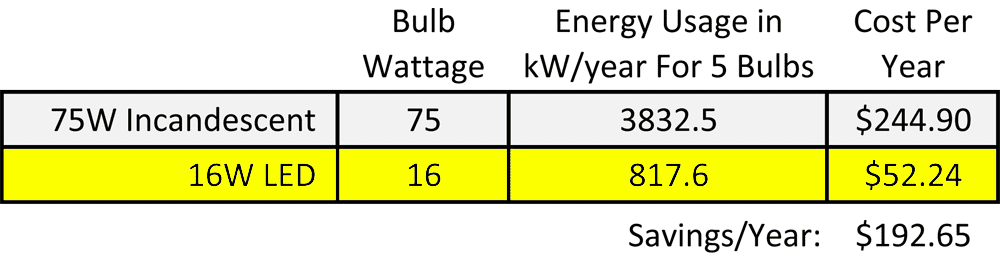
Here is an example of potential energy savings for pot lights in a typical kitchen:
Let’s say you have five 75W incandescent bulbs, and you use them approximately four hours a day, seven days a week. It would amount to 3832.5kW per year. If you were to change these out to five 16W LED pot lights, it would equate to only 817.6kW per year. Based on ENMAX’s current locked-in rate of $0.0639/kWh, it would save you $192.65 per year to switch out those 5 lights to LEDs!
Another incentive to consider is maintenance and waste. The average life span of an incandescent bulb is 1000-2500 hours, while a LED bulb has an average of between 25000-50000 hours. This means you would have to replace an incandescent bulb up to 24 times during the life of an equivalent LED bulb.
Home Automation
Home automation can also be utilized to make your home more efficient and save on your electricity bill. The following are some of the ways that home automation can help:
Check out our top 5 electrical upgrades for cost and energy savings! You can find it HERE.
Use Energy Efficient Appliances
Try to purchase appliances and heating/cooling products with an ENERGY STAR rating when upgrading or replacing them. They will use less energy while delivering the same or better performance than other products in the market. You should also consider the following actions to save electricity when using your appliances:

Electric Heating and Cooling is Expensive
Try to avoid using electric heating or cooling as it uses a large amount of electricity. Portable electric heaters draw a lot of electricity and are much less efficient than heating with natural gas. Average AC units use around 7 kW/h, which means that they will cost you up to about $10/day when running full time (based on $0.0639/kWh, ENMAX’s current locked-in rate).
In conclusion, although a large portion of your bill is not under your direct control, you can still do quite a bit to reduce the electricity you use.
Taking little daily energy-saving actions will reduce your energy bill each month.
With over 30-combined years of expertise in both home & residential AND business & commercial electrical service… we’re At Your Service!
Contact us with all of your home and business electrical questions. Because we’re YOUR local Red Seal, Master Electricians, and are always At Your Service!
24/7 emergency, lighting, Renos, upgrades, automation…whatever your electrical needs, get in touch today!
We’re proud to serve you as your preferred electricians, Calgary, Okotoks, and the Foothills area.
For all of your home and business electrical needs, we’re here for you.
Recent Comments